Chapter Eight: Day One of Trekking: Up, Up, Up!
The day of our trek dawned in glorious gold light over the mountains. This was it! This was the event I had been training for since September. There was no turning back now. The next morning we packed up about half our gear for the trek ahead. Hari’s son, Sajan, would be our porter. He would carry Rob’s big backpack that we would share, and Rob and I would each wear a 15-20-pound day pack with the rest of the things we felt we needed. This left my huge suitcase in storage at the Eco Village with the rest of our clothing and stuff we wouldn’t need on the trail. We would be gone five days.

Water is a scarce and precious commodity in Nepal. Every effort is made to conserve it, both in the cities and in the mountains. We had to pack clothing that could be worn repeatedly without washing or bathing. Most people don't bother much with the latter while on the trail...I should note here that the Eco Village had plumbing, but no hot water, except for what was solar heated in a tank on the village lawn. If you wanted hot water for washing, you took your bucket (provided in the bathroom) to the tank, filled it up, and took it back to your bathroom, where you carefully ladled it over your body with a dipper and let it drain into the drain in the floor. Hari had chosen guest houses on the trail that had "en suite" rooms (attached bathroom), which is quite a luxury. All of the showers we encountered on the trek , except one, had a drain in the floor and the shower head between the toilet and sink. The entire bathroom was your shower. If there was hot water, it was from a solar-heated tank; but - no sun, no hot water. Keep your mouth closed during the washup, and brush with treated water, or deal with the unpleasant results. Luckily, Rob always had his SteriPen with him which quickly treated any water into drinkable, tooth-brushable water.

The solar water tower at the Eco Village
Sajan took one look at the huge stuffed suitcase Rob was lugging into storage and I assured him that we weren’t taking that with us! The remaining pack probably weighed about forty pounds, and Sajan also carried our two sleeping bags on his back. Hari, as guide, carried only what he needed for the trek in one smallish backpack. We loaded up the Indian Land Rover and began a six-hour drive deeper into the Himalayas. The drive was beautiful. As we ascended into the mountains on rugged dirt roads, we began to pass trekkers on foot. I noted that most were considerably younger than we are.

The land rover bumped, jerked, and careened along the mountain roads, through a creek, and pretty much straight up a mountain until it stopped at the end of the road midway up.

Because of my limited lung capacity and energy, Hari had decided I couldn’t do the trek as initially planned, which included about 3000 stone steps straight up a mountainside. He had the driver rumble and bump up the side of the mountain to the halfway point. The place where the driver parked in Ulleri was so steep that the men got out and piled rocks under the tires so the vehicle wouldn’t roll back down the mountain. This would be our starting point for the trek - we were now on the Annapurna Circuit Trail.

We hoisted our packs and headed up the seemingly endless stone stairs that seemed to lead into the clouds. I huffed and puffed, gasping for air, taking breaks as needed, until I thought my lungs would give out completely.

I was still coughing hard. I had been taking some foul-tasting cough syrup for a few days, hoping to overcome my illness and regain full health. I later found out that bronchitis that isn’t cared for can turn into pneumonia. The only reason it didn’t was because of my heavy breathing, which forced the phlegm out of my lungs through the coughing. I “womaned” up and put one foot in front of the other, willing myself up those stone steps.


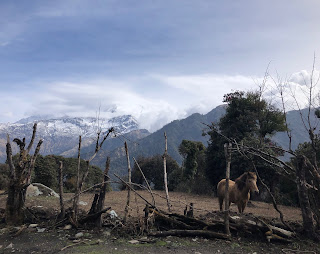
Hari had estimated it would take about an hour and a half for us to reach our first overnight guest house in the mountain village of Banthanti. I dragged myself up and into its dining area like a drowning person being washed up on shore after a shipwreck. But I made it, in slightly less than the time allotted by our seasoned guide. We ate our delicious guest house dinner of rice, vegetables, momos, and lentils, washed down with Masala tea. As we dined, more human and animal traffic passed by. This trail serves as the only "highway" through these villages. We often saw horses, burros, goats, and the occasional water buffalo making their way through the mountains.

Rob and I had the best room in the house, with an attached bathroom with an actual “Western toilet,” i.e. one that you can sit on. There is no heat in these trail guesthouses. There is a bed with a bottom sheet and a duvet, sometimes two, and pillows. This was an upgrade since Rob did his trekking three years ago. We actually didn’t need the sleeping bags at all. I ate my rice and vegetables, drank my tea, and spent a little time painting the mountains in my travel sketchbook before going to bed in thermal underwear, a wool hat and gloves, and wool socks.
Thus ended my first full day of trekking. I could do this. I really could!



Comments
Post a Comment